
Who’s Talking About Holiness?
We’ve Forgotten What It Means to Be Catholic
The greatest crisis facing the Church today is that we have forgotten what it means to be Catholic. Share on XWe have come to treat Catholicism like a social club. We pay our dues. We attend the events. We may even volunteer our time. But being Catholic isn’t really central to our personal identity. Being Catholic doesn’t inform our everyday life.
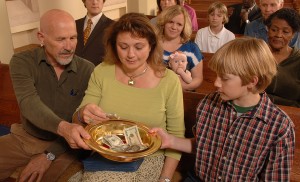
Our faith has to be more than just paying our dues and being part of a social club
What we’ve forgotten is that being Catholic means – first and foremost – to be a member of the Family of God. This isn’t some pie-in-the-sky sentiment. It’s a reality. To be Catholic means to be in a dynamic, growing relationship with the God of the universe. It means to live every day as disciples of Jesus. It means to really and truly participate in God’s divine life.
And the ultimate goal of everything we do as Catholics is holiness – to become holy and to lead others to holiness.
But wait . . . really?
Isn’t holiness just some impossible ideal of perfection? Doesn’t holding holiness up as an ideal just set us up for failure and guilt? It’s just not realistic, is it?
Well . . . yes and no.
Yes – holiness ultimately means perfection and perfection is impossible for us to achieve.
No – but holiness is FIRST a relationship with God empowered by grace. God wants us to be holy, so He will help us get there.
So holiness is not something achievable only by a special few. As the Second Vatican Council reminded us in Lumen Gentium, we are all called to be holy.
Here’s how we do it:
- Make our relationship with God the center of our very lives
- Do everything we can to participate in that relationship through grace
- Let God work in us and through us to build our love for Him, and to bring us to perfection
- Trust that if we don’t actually reach perfection in this life, God will complete the good work He began in us – as long as we persevere.
Being holy doesn’t mean “being good” by our own power. It means being in relationship with He who is Good, and working with Him to become good through grace.
One of my spiritual mentors growing up liked to say, “God doesn’t judge us by where we are. He judges us based on how hard we’re trying to get to Him. As long as you’re trying – you’re OK, no matter where you’re at.”
I don’t know about you, but I caught myself not trying anymore. And the sad thing is that my life is smaller because I’ve stopped trying. I find myself surviving more than thriving. I find myself increasingly frustrated with my life. But how often are we even encouraged to strive for holiness?
Has this been your experience? My pastor (who is a great priest) has been focusing this last year on being a community. Most of the Catholic Tweets and social media posts I see are about abortion and homosexual marriage. People at Catholic social gatherings are more likely talking about sports than God. I hear more and more Catholic organizations talking about what’s going wrong in the Catholic Church and what needs to be fixed. But I hardly hear anyone talking about holiness.
Let me know in the comments if this has been your experience or if I’m just stuck in my own little world.
Let’s start by exploring in more depth what it means to be holy.
Loving God is the Only Guarantee of Holiness
I’ve heard many Christian teachers define “holy” as being “set apart.” And this is true, especially when we are talking about holy objects. A chalice used for the Precious Blood at Mass is “holy” in that it is set apart for that use. We don’t use a chalice as a beer stein.
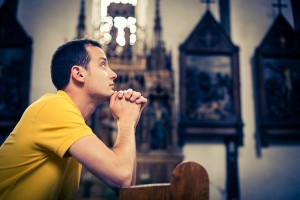
Holy = Loving God.
It’s also true that “set apart” is the root meaning of the word holy.
But when we talk about being holy, we can’t stop there as if God has set us apart, and we’re good. If that’s all there was to holiness, Jesus would not have commanded us to be perfect. So let’s take a deeper look at what it means to be holy.
Yes! We are set apart. If you are baptized, you are set apart as a child of God and co-heir with Christ. You are a prince or princess of the Kingdom. You are the apple of God’s eye.
But just as importantly, you are set apart because you called out by God to be more.
Now, the kind of real, heart-to-heart relationship that God wants to have with us wouldn’t be possible for mere humans, even without Original Sin. But add sin and ignorance to the mix and there seems to be just no possibility at all of reaching the level of perfection necessary to have a real relationship with God. That’s why Calvinists preferred to see grace as “covering” our imperfections. They preferred to see God’s mercy as God overlooking our weakness and accepting us as His children anyway.
But that’s not the picture of grace we see in Sacred Scripture.
Grace invites us into a true relationship. And true relationships require the participation of both people. And this is why holiness is so exciting! We’re not just called to be rescued. We’re called to love – to really love. God wants us to freely love Him. He wants us to participate in His life. Because that’s what people do when they love each other.
Why Does Holiness Lead to the Power of Love?
The two Great Commandments are to love God with our whole hearts, minds and souls, and to love our neighbors as ourselves. When Jesus teaches these laws in response to a question, he tells us, “and the second is like the first – love your neighbor as yourself.” What did Jesus mean when he said that love of neighbor was like love of God? When the Church teaches the two Great Commandments, She tells us that we love our neighbor for the sake of our love for God. What does that mean? Unfortunately most answers we receive to these questions are pretty sappy romantic notions and not really helpful.
But the relationship between the Great Commandments becomes much easier to understand when we recognize that the family is God’s model for the Kingdom of God. Holiness calls us to love our neighbor first of all because we love God as members of His Family. To love our neighbor is truly to love our brothers and sisters – which means to love our Heavenly Father because in loving our brothers and sisters, we are loving what He loves.
In fact, Jesus starts with the Great Commandments, but then gives us a new commandment – to love one another as He loves us. How does Jesus love us? He loves us by giving Himself to us completely as a gift – holding nothing back.

If we love God, we’ll love the people God loves
Jesus’ command to love was not “be nice to each other.” It was “take up your cross and follow me.” Sacrifice everything for the sake of love.
Now, what would happen if I tried to love people that way? Honestly, there would be nothing left of me. Seems a bit self-defeating, doesn’t it?
But when Jesus tells us to love as He loves, He is really telling us to love others with His love. The Resurrection proved that Jesus – as God – is able to completely (and continually through the Holy Eucharist) pour Himself out for us and never exhaust Himself. He is eternal and without limit. So when I love with the love of Jesus – through grace – I can pour myself out because it is Jesus who is loving through me. And when I love that way, I am participating in the very life of God.
OK – I know this is mind bending. But does it make a little sense? To love our neighbor the way Jesus calls us to means to participate in the love of God – and that is part of loving God.
But one myth about Christian love is that it is altruistic – that we are called to love and to expect nothing in return. That’s not quite true. We love because we are made for love. It is a proven truth that human beings find their greatest happiness in loving relationships. So to embrace a life of holiness means to build more loving relationships (more in quality and in quantity). That means a greater share of fulfillment and happiness. God shows His love for us by calling us to love!
That’s just cool.
3 Ways to Unlock the Awesome God Placed Inside You

Nothing unlocks inner potential like holiness!
But sin and ignorance damages our ability to reflect God’s glory. Our character is damaged. Our gifts are muffled. Our goodness is broken.
The good news is that through grace we can reclaim the greatness God placed within us. It’s not automatic. It requires us to cooperate with grace and to strive for the goodness that God created within us.
But grace has the power to completely redeem us – to allow us to reclaim the piece of glory God placed into each one of us. What do we need to do is to cooperate with grace – to cooperate with God and the changes He is making in us. Here are a few ways we can do that:
- Live a fully human life. This is what “natural law” leads us to do. We are an integration of body and spirit, and our spirits (especially the intellect and the will) should govern the body. This is how we more perfectly reflect the attributes of God.
- Overcome sin and grow in virtue. Our
- Activate our natural and supernatural skills and abilities in service of the Church and the world. We are all called to the “Great Commission” the word commission means a shared mission. Each of us is called to participate in Jesus’ mission as priest, prophet and king. And the Holy Spirit equips each of us to participate in that mission in a unique way. Discern and activate those gifts and get active in your mission!
Those are a few key steps in cooperating with grace and growing in holiness. Doing these things not only directs our life toward the goodness that God has planted in us, it also removes the blockages in our hearts that keep us from truly being the unique individual God created us to be. Have you ever noticed? Even though the saints share a love for Jesus and a love for goodness, they are all incredibly unique! That’s what God wants for you.
Why Holy People Live More Passionately

This is how much God loves me!
There’s another myth about Catholic spirituality – that a life of faith means sacrificing worldly good. God actually created the world to be a sign of His love for us. All of creation was a sign of the first Covenant that God made with Adam and Eve.
The problem is that fallen human beings are always tempted to love the sign more than the Person. We fall in love with the gift and forget the Giver. That’s one reason that sacrifice is part of Christian spirituality.
But another part of Christian spirituality is to accept created goods as a sign of God’s love.
When we put created goods in their proper perspective, we start using them according to their intended purpose. This actually means that we enjoy them more, but without becoming obsessed with them.
So people who are striving for holiness are actually more likely to have a deeper appreciation for created goods. I think that’s why Catholic monasteries are so often associated with things like coffee or wine or bread – and why so many priests are foodies at heart!
3 Ways to Embrace the Adventure of Holiness
Faith is not meant to be just one part of our lives among many. Share on XIn fact, faith should inform our life’s purpose. It should be at the center of everything we do.
God does not want us to be passive observers. He calls us to be active participants in His divine life, partners in His mission.
In addition to our call to love and our call to conversion, God gives us a call to mission. This mission takes three forms in our life.

Scary but exciting? That’s what living the faith is all about!
- Our office is where we are called to wield the authority of Christ as His ambassadors. Ordained clergy have a clear office in their parish or diocese. But lay people have an office too. They have the power and responsibility to speak on behalf of Jesus for their spouses, their children, and anyone else God puts in their circle.
- Our vocation is our particular school of love, where Jesus calls us to learn to love as He loves. Priests are called to love the members of their parish or diocese. Religious are called to love members of their order – and to pray for the world. Those who are married are called to family love. These calls are give specific grace to help us love with the love of Jesus.
- Our mission is the particular way God calls and equips us to participate in His mission.
These are the high adventure of holiness. Like any high adventure, the life of holiness can be difficult and even scary. But it is also incredibly exciting and – in the end – fulfilling.
Does this sound at all like your faith life? Does a life of love, personal perfection, living life to the full, and embracing life as an adventure sound like the life you’re longing for? This is what it means to be holy. This is the life you’re called for.
If you’d like to join me in pursuing it – even if you’re just a beginner in the spiritual life, I’d like to invite you to a free online course called the Keys to Spiritual Growth. This course introduces you to 5 key areas of Catholic spirituality that we can learn practical strategies to grow in.
Just click the button below and fill out your first name and email. I’ll send your login information right away. This course is quick, easy and free, but it will get you started living this life of adventure. Let’s keep talking about holiness! Don’t let the conversation die. Get this free e-course today.