Foundations of the Theology of the Body
The Theology of the Body by Saint Pope John Paul II is a deep and fruitful reflection on human nature, human relationships, marriage, human sexuality, and the role the human body plays in God’s plan of love for us. However, most people find this teaching to be a real challenge. It’s a very long document and it is theologically and philosophically complex. Having somebody break it down for you into specific concepts you can understand and put into practice is the best way to get the most out of this important teaching. This guide will introduce you to the most foundational concepts of the teachings of Pope John Paul II.
What Is the Theology of the Body?
Between September 5, 1979, and November 28, 1984, Pope John Paul II dedicated his Wednesday audiences to catechesis on human nature, human sexuality, and human relationships. He gave 129 lectures explaining the meaning of the body and its role in God’s loving plan. While many perceptions limit these teachings to the topic of sex, his actual lectures spanned much wider than that. He offered a complete anthropology (description of human nature) that included God’s original plan before Original Sin, human life after Original Sin, and God’s plan for the redemption of humanity.
Pope John Paul II did not create any new doctrine in his Wednesday audiences. Rather, he compiled the Biblical, doctrinal, and theological tradition of the Church. However, he presented this tradition with his phenomenological approach. What does that mean? Pope John Paul II tried to show how doctrine and theology are more than remote academic exercises. They affect each individual within the context of our daily lives. This approach makes the concepts Saint Pope John Paul II teaches at the same time profound and practical. In other words, learning this theology can help you grow in holiness.
Dr. Scott Hahn explains how he discovered Pope John Paul II’s teachings as they were happening and offers an analysis. Are these teachings divergent from Catholic teaching or convergent? Click here to watch the video and read the summary: Scott Hahn Explains the Theology of the Body.
This guide divides the foundational concepts into three considerations. First, we’ll consider what it means to be human. Second, we’ll consider the centrality of relationships in human life and how they have been transformed first by sin and then by grace. Finally, we’ll consider the significance of sexuality – being male or female.
The First Consideration: What Does It Mean to Be Human?
One of the main points of Catholic anthropology is that human nature is a unique integration of body and spirit. God did not create human beings as spiritual beings. He created us with a physical as well as a physical nature for a reason. He created spiritual beings with no physical form (the choirs of angels). He also created physical beings with no spirit (plants and animals). Human beings are the only creatures with an integration of the physical and the spiritual. The primary reason for the unique composition of human nature is that human beings are created to make spiritual realities present to the physical world. Human beings are created in the Image of God, making our ultimate purpose to make God present to the physical world.
In the Image of God
Pope John Paul II called his work the Theology of the Body precisely because the human body teaches us something about God. By reflecting on human nature, we can also reflect on the Divine Nature. Human attributes reflect the attributes of God.
- God is eternal (He has no beginning and no end). Human beings have a beginning but we are created to live forever.
- God is TRUTH. Human beings have an intellect with a boundless ability to know the truth.
- God is sovereign. Human beings have a free will to exercise sovereignty over their own lives (subject only to God) and over Creation.
- God is LOVE. Human beings are created with the capacity to give and receive love.
- God is transcendent, existing beyond time and space. Human beings have the ability to consider ideas beyond the bounds of time and space.
This list could go on-and-on, as great Catholic minds like Saint Thomas Aquinas and Saint Bernard of Clairvaux. have developed entire treatises on how human nature reflects God’s attributes and on how reflecting on human attributes can lead us to consider God.
But there’s another significance for the Image of God. God created human attributes not just to reflect His attributes, but to RECEIVE them. In other words, God created human beings to be in a relationship with Him in a unique way.
- The Tree of Life shows that our immortality is a gift received by God. Death came from turning our backs on the author of life.
- The intellect is created to receive the TRUTH that emanates from God.
- Free will is the ability to choose, and therefore receive, the GOODNESS that comes from God.
Human nature is created for intimacy with God and to love Him. As we’ll see in our explanation of the concept of Historical Man, Original Sin damaged our ability to reflect God in the world and to receive Him. However, it did not destroy these abilities. As we’ll see as we explore the Eschatological Man, the grace of Christ not only restores these abilities but elevates them.
Learn more about how the body and the purpose of human life. Click here to read the article Why God Gave Us Bodies.
We Live What We Believe About the Body
An unwritten rule is that we live what we believe about the body. Our bodies are integral to the purpose of our lives. If we understand the proper integration of the physical and spiritual aspects of human nature, we will live lives filled with balance and dignity.
However, there are also many errors about the body that also affect the way many people live. Some people adopt these errors consciously, but others adopt them ignorantly simply by following the lead of our culture.
It’s important for us to know about these errors so we can protect ourselves against them. Click here to learn more about 3 Myths About the Human Body.These errors are not just a difference of worldview or opinion. They lead us to live our lives in ways that cause us pain.
Original Man | Historical Man | Eschatological Man
Pope John Paul II explores human nature and human relationships through the lens of Salvation History. This approach shows us God’s original plan for human life, how Original Sin pulled humanity out of that plan, and how God not only redeems but elevates that plan through Christ.
The Holy Father refers to Adam and Eve before the Fall as “Original Man.” Reflecting God’s original plan for human life, “Original Man” enjoyed a number of natural and preternatural (i.e. gifts of grace) characteristics. Pope John Paul II refers to these conditions with the moniker “original” (again, mostly following Catholic tradition). For example, human nature before the Fall enjoyed “Original Justice.” Original Justice was the state of internal harmony in which the human personality was ruled by the intellect (truth) and governed by the will (free choice). Our physical desires and passions were governed by the intellect and the will so we were always able to choose the greatest possible good.
After Original Sin, human nature and the human personality are fallen. Saint Pope John Paul II refers to our present state as “Historical Man,” since it describes the state of humanity within known human history. Original Sin happened before recorded history. Our redemption will be completed at the end of human history. Within this time of history, fallen humanity struggles to love as we are created to do. Selfishness, lust, sin, and ignorance keep us from fulfilling the purpose of our lives. We can begin to reclaim authentic human and divine love by cooperating with grace, experiencing the transformation of our hearts, and growing in virtue. However, our sinful nature makes necessary constant vigilance, repentance, and conversion as the process of redemption works in our souls.
The life of grace is available to us now, but it will not be perfected in humanity until the Lord Jesus Christ claims final dominion and puts all things under His divine rule at the Last Judgment. When Jesus finalizes his conquest of Original Sin, the life of grace will be fully active in each soul that chooses to be a member of His Kingdom. The Final Judgment is known in Greek as the Eschaton, so Pope John Paul II calls humanity in this perfected state “Eschatological Man.” Not only will Eschatological Man reclaim God’s original plan for humanity and human relationships, but through grace, we will also be perfected as we become Christlike, especially in our ability to love.
We explore these three stages, especially as they relate to human relationships, in the online course, “The Two Are One.” Click this link to check it out!
The Second Consideration: the Transformation of Human Relationships
The Theology of the Body does not teach only about the human body or sexuality. It’s really about human nature and human relationships. The Creation story tells us that relationships are central to human life. The very purpose of our life is to know, love, and serve God. Because God created us to be members of His Family, loving each other is an integral part of loving God. As he explains the transformation of human nature by Original Sin and then by grace, Pope John Paul II also discusses the transformation of human relationships. He shows that relationship is an essential part of human nature, and is transformed with it.
Original Solitude
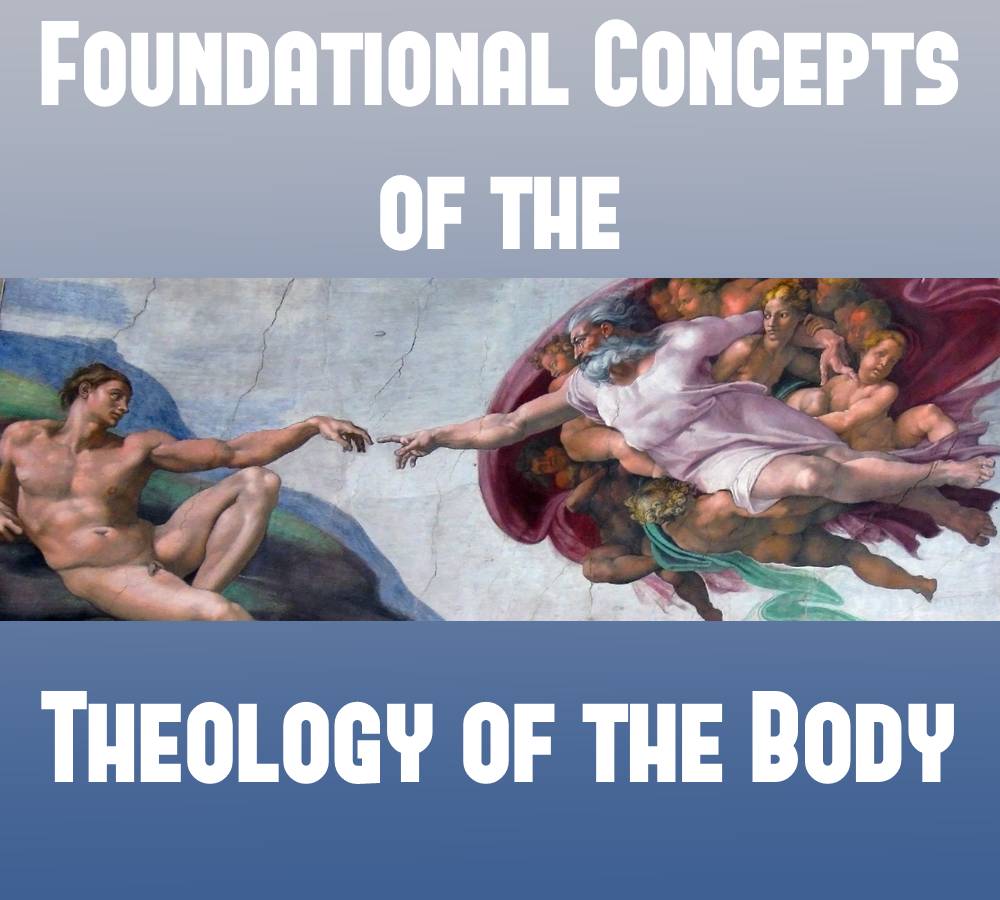
Before the creation of Eve, Adam was alone in the Garden of Eden. Pope John Paul II describes Adam’s solitude as a more profound experience than simple loneliness. In fact, this experience was not all negative. Reflecting on it allows humanity to reflect on its nature. Adam had the animals and all of the blessings of Creation, but none of them were suited to be his companion. Adam also had a Covenantal relationship with God. Yet, he was not God and was therefore not able to enter into a true relationship with Him (as we are through grace). Original solitude taught Adam that he was a unique creation – not an animal, not an angel, and not God.
The negative dimension of Original Solitude is expressed by God in Genesis 2 when He says, “It is not good that man should be alone.” Again, Pope John Paul II points out that God’s statement points to something more profound than mere loneliness. Adam was created in the Image and Likeness of God. But he could not complete this Image and Likeness by himself. God is three divine Persons existing in a relationship of perfect love. So Adam needed to love another like himself in order to complete the Divine Image. Original Solitude revealed to Adam who he was.
Original Unity
When God creates Eve, Adam exclaims, “This one, at last, is bone of my bone and flesh of my flesh.” Here, at last, is one like me with whom I can give and receive love as my equal.
Adam and Eve enjoyed a relationship of perfect love with each other. They were able to perfectly give themselves to each other and perfectly able to receive each other as a gift.
Original Innocence
Adam and Eve were naked but were not ashamed. Pope John Paul II says that they were not ashamed because they enjoyed a kind of innocence. But this innocence was not the naive innocence of children who don’t realize that running around without clothes on is not appropriate behavior. Rather, Original Innocence springs from Original Justice and Original Unity. Adam and Eve, knowing only goodness and love, were free from sin. They were able to choose the greatest possible good in every situation and to see God’s love in everything they chose. Selfishness and lust did not enter into their personalities or into their relationships until after the Fall. They were therefore able to be perfectly naked before each other and before God, knowing that they were accepted and loved. Their physical nakedness was an outward sign of their emotional, psychological, and spiritual nakedness. They had nothing to hide from God or from each other.
Nuptial (Spousal) Meaning of the Body
Perhaps the central concept of the Theology of the Body is that the human body has Covenantal meaning stamped into it. The male and female bodies are created to fit together. Those body parts – the parts that we most carefully cover and protect – are the parts intended as a gift to the other.
A key part of the nuptial meaning of the body is that our bodies teach us that we are meant to be a selfless gift to others. Being a gift to others is the very definition of the virtue of charity. We are called to love one another as Christ loved us.
Another dimension of the nuptial meaning of the body is that the male and female bodies represent the Covenant between God and His People. The way the male and female bodies come together in the sexual act especially signifies the way God unites Himself to His people. We call God “Father” because like a biological father, life and goodness come from him. The Church is called “Mother” because like a biological mother she receives life and goodness and nurtures it.
Marital grace is often underestimated. A true understanding of marital grace leads us into the Mystery of human redemption. Click here to learn the true power of marital grace.
Lust
Original Sin damaged the language of the body by introducing lust to human nature. Lust has a general meaning that is often called “concupiscence” in Catholic theology. In general, physical desires tend to be out of proportion to the good that is appropriate to us, and they tend to be uncontrolled by the intellect and the will. Pope John Paul II focuses on the three “lusts” identified by Saint John: the lust of the eyes, the lust of the flesh, and the pride of life.
As a specific sin, lust means more than just sexual desire. Lust means to treat another as a thing to be used rather than as a person to be loved. As such, lust opposes the nuptial meaning of the body, which is about giving and receiving. It replaces it with selfish taking.
One of the main ways we are called to combat lust is to exercise the virtue of self-control. Click here to read about how self-control can lead to true human happiness and how our culture leads us in the opposite direction.
Shame
Most people see “shame” as something negative – an attack on one’s dignity or self-esteem. But John Paul II describes shame as a necessary response to lust.
First, shame literally means to “cover” what is sacred. When lust endangers the nuptial meaning of the body, we need to cover and protect the sacred parts of the body that are meant as gifts for the other.
Second, the feeling of shame is the desire to cover one’s face or to hide because we recognize that we have profaned was sacred and continue to endanger it with our lust. this was why Adam and Eve hid from God in the garden after the Fall.
The Third Consideration: The Significance of Sex
The nuptial meaning of the means that there is more to being male and female than biological reproductive processes. Being male or female has deep human and theological meaning. Therefore, how you live your femininity or your masculinity has a deep impact on your life and your faith.
The sense of shame should lead us to develop the virtue of chastity. Chastity is a misunderstood and undervalued virtue today. Click here to learn what chastity really is (and what it isn’t) and why it’s essential for protecting human dignity in a fallen world.
Feminine and Masculine Genius
Pope John Paul II developed the idea of the significance of each sex after Theology of the Body was compiled. Specifically, he explored what he called the “feminine genius” in his apostolic letter, “Mulieris Dignitatem,” which has the English title, “On the Vocation and Dignity of Women.”
The word “genius” doesn’t primarily mean brilliance. It actually means “uniqueness” or “unique strength.” The idea of a “feminine genius” is that women bring a unique set of qualities to everything they do. This uniqueness comes from their biological, cognitive, emotional, psychological, and spiritual differences from men. Women by their feminine nature have a different way of seeing the world than men and a different way of approaching things.
Likewise, men have their own “genius,” their own masculine way of seeing the world, and their own masculine approach to things. The idea of a genius means that neither the male nor the female approach is better than the other. They are simply different. Both are necessary. Both are to be celebrated.
Learn more about the beauty and power of the sexes in the online course “The Genius of Sex.” Click here to learn more and to purchase the course if you want to dig more deeply.
Complementarity
Another reason to celebrate the uniqueness between men and women is that, far from driving a wedge between the sexes, they can actually increase harmony, intimacy, and love.
God created men and women to be different from each other but in a very specific way. Men and women complement each other. In other words, female strengths can compensate for male weaknesses, and male strengths can compensate for female weaknesses. Likewise, male strengths provide for a woman’s greatest innate needs, and female strengths provide for a man’s greatest innate needs.