Exploring Active Styles of Prayer
Spiritual growth requires us to form a consistent habit of prayer. Because prayer is a relationship with Jesus, we need to find ways of praying that fit our personality and our relationship with our Lord. In our last article, we talked about various styles of prayer for people who are drawn to more quiet, meditative prayer. In this article, we’ll discuss prayer styles that are a little more active and engaging. While one style of prayer may reflect your personality better, it is also true that we need different styles of prayer at different times in our life. I tend to be more quiet and meditative, but when I have trouble focusing I try one of the options below.
Charismatic / praise & worship prayer
On the other end of the spectrum from meditation in some ways is charismatic prayer. Charismatic prayer is based on an active, experienced relationship with the Holy Spirit. It is often characterized as “emotional” prayer, and there is definitely a more emotional dimension to it. But the focus of charismatic prayer is on relationship. There are some extraordinary expressions of this relationship when the Holy Spirit bestows his gifts on those who are open to receiving them. Praying in tongues is the most common gift. Other charisms include prophecy, spiritual warfare, holy tears, holy laughter, resting in the Spirit, interpretation of tongues, and discerning spirits. Not everyone experiences these charisms, and that’s OK. Again, the focus is on the experienced relationship with God through the Holy Spirit. Praise & worship music is very much part of charismatic prayer, and can be a great way to experience this kind of prayer. Pray the words of the songs and let the music move your heart to greater expressions of love for Jesus.
Rote Prayer – with meaning
Sometimes memorized and pre-written prayers can get a bad reputation. Sometimes rote prayers can be performed mechanically and brainlessly and therefore can be pretty meaningless. But really, any prayer can get this way when we lose sight of the relationship at its root. Try reciting rote prayers while really thinking about what they are saying and what they mean. Pray the “Hail Mary” and look up in the Bible where the two parts of the prayer come from. Pray the “Our Father” and really think about what you are asking the Father to do for you. Pray the “Memorare” and the “Ave Maria” and really think of what they are saying about Mary. Pray the Morning Offering and the Anima Christe and think about how your life would change if you really lived in accordance with the grace these prayers offer you. These traditional prayers are actually filled with a lot of beauty and wisdom.
Formula prayer – “teaspoon (tsp)” = “thank you, sorry, please”
Often “spontaneous prayer” or conversational is promoted as the only form of authentic from-the-heart prayer. The truth is, any prayer can be from the heart and any prayer can be done mechanically, including “spontaneous prayer.” Many people who think they’re praying spontaneously have unconsciously fallen into their own formula. The key to prayer is to put your heart into your relationship with God no matter what form of prayer you’re using. But at least conversational prayer acknowledges that prayer is about relationship, and that’s a good thing.
And adding conversational prayer to your toolbox may be a good idea. It can remind you that prayer is relationship. But many Catholics who are used to liturgical and rote prayer are uncomfortable with conversational prayer. Catholics will often fall into the familiar “we pray to the Lord” style of petition and intercessory prayer (and there’s nothing wrong with that, either – except that it tends to focus the prayer only on those two functions of prayer).
One great option is to use a formula prayer. A formula prayer is an outline for conversational prayer. It doesn’t offer words to use, but a framework for what to pray about. One such formula is the “teaspoon” prayer. This formula uses the abbreviation for teaspoon, tsp, as an easy to remember acronym. The formula TSP stands for
T: “Thank You” – Tell God what you are most thankful for! Believe it or not, this step is actually the beginning of praise. Praise is simply giving God glory for the good things he does for us.
S: “Sorry” – The Church recommends a daily examination of conscience (not something I’m in the habit of doing yet – that might be my next goal in the prayer Key). Acknowledging that you are a sinner in need of grace has a beautiful flip-side to it – realizing that God loves you anyway and is waiting to forgive you as soon as you ‘fess up. So confess your sins – whether they be venial or mortal – on a daily basis. Don’t forget to go to Reconciliation if you have mortal sins on your conscience, but until you can get there this is a great beginning to true sorrow for your sins.
P: “Please” – Putting your prayers of intercession and petition at the end reminds you that the purpose of prayer is relationship, not getting stuff from God. But it’s still good to ask God for what we need. Remember – petition and intercession is a participation in the goodness and love that God wants to bring to us and to others. So go ahead and ask for what you need! Then ask for God’s will to be done, and for you to be part of that will, whatever it may be.
This simple formula will get you talking to God from your heart.
Active prayer – prayer walk, prayer journal, drawing
Some people struggle with prayer simply because they can’t sit still that long. I don’t mind sitting still, personally. But there are still times when I can’t focus on prayer and I just need something more to get me engaged. Those are times when I engage in active prayer. Active prayer simply means praying with your body.
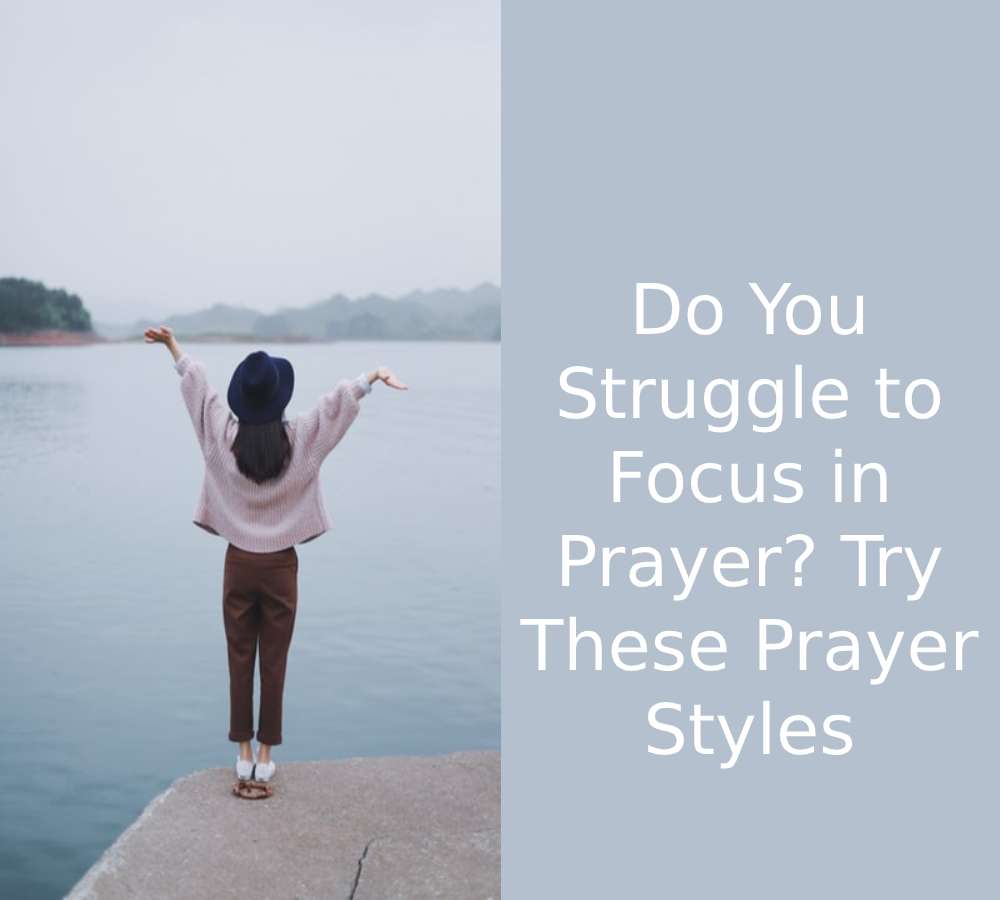
The simplest physical prayer is to become aware of your posture during prayer and to consciously use your posture as part of your communication with God. Traditionally, this meant praying on your knees. Many people in the charismatic movement pray by raising their hands to God or by adopting an open posture.
Another kind of active prayer is pairing your prayer with an activity that you already do. I like to pray while I walk for exercise. Some people might pray while they knit or sew, or while they do some other activity they enjoy. The only criteria is that the activity leaves the mind free to focus on God. So praying while your working the daily crossword probably wouldn’t work so well.
One final mode of active prayer is to keep a prayer journal or do some other writing while you pray. Writing really helps keep me focused in my prayer. Keeping a prayer journal is also a great way to record who God is working in your life. Sometimes you don’t see God at work until you look back at where you came from. If you’re the more artistic type, you might consider drawing or doing some other form of art while you pray. A formalized version of prayerful art (or artistic prayer) is the practice of “praying icons.” The creation of an icon is actually done as an act of prayer, and the icon is then used as a focal point for meditative prayer.
Micro Prayer – post-it notes, mirror prayers, “ejaculations”
Prayer doesn’t always have to take a long time, either. In fact, one really good practice is to pepper your day with really short prayers to help you keep God at the center of your day. Traditionally, these short prayers have been called “ejaculations” – an unfortunate word to modern ears. They are usually one or two sentences long. The most famous one is, “Jesus Christ, son of God, have mercy on me a sinner.” But you can make up your own prayer, or use a couple of sentences from a prayer you like.
I often find it helpful to write these prayers on a post-it note or to hang a prayer card on my bathroom mirror, the refrigerator, or a kitchen cupboard. Seeing the note or card reminds me to pray.
OK, some homework for this time around as for last time around. Choose one of the prayer methods from the active prayer list and give it a try. Then come back here and tell us about your experience in the comments section!
Brought to you by Jeffrey S. Arrowood at From the Abbey, dedicated to helping you rediscover the JOY of learning and living your faith so you can grow in intimacy with God.
I would like to ask for prayer for gucdanie. I would like to ask for prayer for my finances. I would like to ask for prayer for true happiness and strength to put God back into my life as i was raised by both my mother and father.Thank you Jesus for always watching over me. Thank you for the trials and tribulations that you have guided me through, it has made me a stronger person. Thank you for my job. Thank you for the life that you have given me along with my children.Amen, Amen and Amen AgainI am so grateful for everything nad everyone.